Monday, 17 March 2014

Battle Royale: HANNIBAL: CLOUDS OF WAR by Ben Kane


Clouds of War by Ben Kane
Forget the book for a second, lets have a look at that cover! What a beauty. One of the most eye catching covers I have seen in the genre of historical fiction. Of course, covers are as much about personal taste as stories are, so I don't expect everyone to feel the same way.
I am so sick of seeing men or women in period dress on historical fiction covers. Some of them are very well designed, inspirational to the imagination and eyecatching, but it is the sheer volume of man or woman in period costume covers that has me bored with them.
While the cover of this Hannibal: Clouds of War edition does have a man in period costume on it, the combination of colours, the font choices and the pose make it something fresh and it is likely this will be my favourite cover of 2014.

But we are not here to read what I think about the book cover are we? We are here to talk about the words beneath it. As we get beyond the book cover to imbibe of a battle royale between two mighty military forces of ancient history. The Romans and the Carthaginians.

This is the third instalment in Ben Kane's Hannibal series. I skipped over the first one, Hannibal: Enemy of Rome, because it was taken up by the childhoods of our main characters. Since I prefer adult characters, I came in on book two, Hannibal: Fields of Blood.
I liked the book and reviewed it last year. I believe the reader doesn't need to read book one to understand the one following it, but it may serve a reader best if they do start with book one and not jump in elsewhere like I did.

I liked Hannibal: Clouds of War more than I liked the book that came before it. I have spent many moments trying to work out why I prefer it, but I come up empty handed. I simply did and that is that.

Ben Kane is a consummate professional when it comes to his researching. He goes to great lengths to research for each book. Going to historic sites in Italy, Sicily and beyond. Visiting ancient battlegrounds to get a feel for how his story and his characters might fit into the landscape.
I have watched the author's videos on events such as the Battle of Cannae, and seen him talk/write passionately about his historical context. I think if an author has the opportunity to travel for research, then do it, because it shows, I can tell you.
As an avid reader of historical fiction, I notice the structure this kind of hands on researching can inject into a story. It had an unmistakable footprint in Clouds of War and if you like that sort of thing like I do, then you will notice it too.

While I do struggle with how I feel about the dialogue in this series, it is the fantastic sense of place that keeps me reading. I love to feel immersed in an era when I read. In fact, as with many of us, it is why I read historical fiction in the first place. To time travel.

Everything you would expect from Ben Kane is in this novel. History and dense, lengthy battle scenes. Your major characters - who you will have come to like or love or hate via the two books that precede it - will be there to meet you also. They are all in there and if you read this author for any of those - the battles, the history, the colourful characters - then you will be well pleased with what you find.

On a final note. Great glossary. (If only all authors would include such a detailed glossary in their historical fiction books). Brilliant historical note. (When will this author realise that he has the knack with the simple matter of talking history? Which graduates well to writing non fiction. I'll buy that non fiction if it comes, for sure.)

- MM

Friday, 14 March 2014

Peace, Love and Good Books: HAWK QUEST by Robert Lyndon


Hawk Quest by Robert Lyndon
As someone who likes to, and wants to, review every historical fiction book I read, it is no great pleasure of mine to review books that I have less than positive opinions on. In a perfect world I would love or like every book I read. Every review would be glowing. Faults would be minor and opinions on them would not be offensive to the author or his or her fans. Smiles all round. Peace, love and good books forever more.
It would make reviewing so much easier and I could move on guilt free to the next book. The next happy, positive review.
Only this isn't a perfect world. Books are not all equals. Authors are not all equals. And as much as I want to love or like every book I read, it simply is not going to happen.

Which brings me to my review of Hawk Quest by Robert Lyndon. A book I had such high hopes for. Set in a favourite era and based on a journey. (Journey being one of my favourite devices in historical fiction).
It should have been a perfect match and by jove, for approximately 80 pages it nearly was. It had one of the greatest introductions that I have read for years. It was intoxicating.
The author's grasp of descriptive device was exemplary. Appealing to my every nuanced taste.
A few small examples;

He'd covered less than half the distance when the clouds snuffed out the sun. The temperature plummeted. A wind that started as a faraway sigh struck him with a blast of hail.

and...

The squadron descended on them like a machine welded by flames, the torches roaring in the wind of their passing .

I admire great writing, great description and great imagination. If an author can combine this triumverate of greatness in the ways quoted above through an entire book, then I am putty in their hands.

But then what happened?? The book I was reading in those early pages transformed into something that was very nearly the antithesis of everything I loved about the first approx 80 pages.
Magical passages of description and beautifully devised scenes, were replaced by rushing, clunky sentences. Simplistic in nature and lacking in skill. The writing became a shadow of its former self. Dialogue became naive and unchallenging. 
It was choking on too many pointless plotlines. Bad passes of dialogue. Historical inaccuracies. Needlessness. Something went awry with this novel and it was a bloody crime to me.
The writer became his own obstruction and as a result, inconsistencies in writing qualities reigned supreme and I had to force myself not to abandon it.

This author has the ability to be quite brilliant. The talent is there. I have no doubt of that. Had the book been shorter, more refined, it would have given it a better chance and if only some of the scenes and storylines had been ruthlessly removed, this could have made it a magnificent specimen of the genre. 
It could have been the epic (a shorter one) that the author had wanted it to be. If only..if only...

I will not give up on him yet though. I have bought the next book Imperial Fire. Those glimpses of brilliance are enough of an incentive for me to believe this author will come into his own one day.
With experience and bucketloads of feedback from readers, this author will be a shining star in the genre of historical fiction. And I want to be there when that happens. To applaud it.

- MM


Thursday, 13 March 2014

The Final Countdown: ODIN'S WOLVES by Giles Kristian


Odin's Wolves by Giles Kristian

I have said it before, and I will say it again. I truly do love these kinds of Viking historical fiction. They are books that mingle the sagas with excellent penmanship and colourful adventure. I could read them every week for the rest of the year and be every bit the contented reader.
My journey with this series has not been without its own twists and turns and literary adventures. From the hiccup that was my first attempt with the series a couple years back, to the rediscovering of the series in 2013.
To think that I nearly missed out on all this Raven fun by not giving the first book the time it needed to grow on me.
Luckily, I gave it that time at a later date. With a reread. And it was that reread of book one, Blood Eye, that brought me the long way around to this book, book three in the Raven series, Odin's Wolves. (of course, I must not forget that I got there via the 5 star stepping stone between them: Sons of Thunder).

For most of this book I was infatuated. The writing, the adventure, the characters. The delightful balance of all three had my heart racing and my mind flying.
Giles Kristian's vivid scenery and zesty stories have stirred my imagination over and over. At times, his studious pictorialisation has even surprised me. Me, a deliberately and willingly jaded reader of Viking fiction and Viking non fiction. Yes, I still can be surprised. I love it when authors keep it fresh. Adding their own ingredients to the well traversed literary landscape of Viking historical fiction. 
Nothing worse than feeling an author got his or her knowledge from Wikipedia. And I can promise, you will never get that feeling from these Giles Kristian Viking books. This author's inspiration comes direct from his own imagination, and not indirectly through the imagination and research of others.
One of those surprises came in his description of Yggdrasil. He gave me a whole new way to imagine the tree of life and - in the same breath - gives explanation of how it may have been imagined by these early travellers and raiders. I even marked the passage to quote here in this review and then I went and put the book aside for a couple months (I was that far behind in my reviews). In the process I lost my marks and so too did I then lose the page where Yggdrasil - and the birds flying amoung its branches in the sky - had been described.
You will just have to take my word for it. It was beautifully described and wondrously fetching to the mind's eye.

As you may have guessed by my words in the last paragraph, for 'most' of the book I was infatuated. Disappointingly, it was not all a source of infatuation for me. This, I am happy to say, has nothing to do with the author's story nor his writing. The fault lays with me and my deeply ingrained disinterest in Romans.
I cannot say too much on that without giving away plot lines. Fear of spoiling the book for others leaves me with little room to manoeuvre when giving my personal opinion of the second half of the book.
Let me just say that, through no fault of the author's, I found myself at an impasse. My favourite culture of history mingling with my least favourite. Viking meets Roman. To others that would sound wildly exciting, but for me, when that happened, to the lengths that it did, the book and I suddenly became incompatible. But it is still a terrific book and I still give it 4 stars out of 5. Majority of people will not have any problem continuing to enjoy the book passed the point where I stopped enjoying it.

I would recommend nobody be put off reading the book by me confessing that I did not enjoy the last half as much as the first. As you all know, sometimes, no matter how good the book is or how well it is written, if the subject matter it not compatible with a reader's personal tastes, there is nothing one can do. Try as you might.

Now that I have finished this trilogy, I am even more excited to read the latest instalment which is due out this year. God of Vengeance is a prequel to this Raven series. I have read the blurb and I am thrilled to my boots by the premise. Bring it on!!


- MM


Monday, 3 February 2014

Chariots of Fire: ROME: THE EMPEROR'S SPY by M.C. Scott


The Emperor's Spy by M.C. Scott
Manda Scott is a brilliant writer. Such a talent.
It has been a couple years since I read some of her Boudica series and while I don't always love the story I do always love the writing quality.
The Emperor's Spy is no different. The writing is highly skilled and even though her story did not always appeal to me, the skill of her writing is never in question.

I believe, for my tastes, the story of Pantera here in The Emperor's Spy has much more to offer me than the Boudica story and I loved the read for most of the book.

From the get go, this book had me hooked. I enjoy a good spy or assassin character and Sebastos Abdes Pantera was one of the best. Cool headed, slippery, charismatic. He is a character I can really sink my imagination into. He is also a character, amoung a few others, who have been carried over from the Boudica series, but by no means do you have to read the Boudica books to enjoy The Emperor's Spy.

I did give it 4 stars not 5 and here's why. While the novelty of the Chariot racing delighted me in the beginning, throughout the rest of the book it wore off and I lost interest in it. I felt there was too much blow by blow of the ins and outs and ups and downs of the sport. In the ring and in the background, but I am sure this won't be reflected in all readers experience with this book.


The other thing that truly bothered me has to do with the ending. The only way for me to talk about it is to mark my thoughts in a huge spoiler alert..


SPOILER! Shield your eyes!
I don't get much out of tender love scenes. The touching, the stroking, the adoring. Don't want to betray my sisterhood, but I find it a weakness in women's writing. So, when I made it through nearly the entire book without any love scenes I was thinking this may be pushing 5 star for me. But then the party was over. And the last few chapters of this book would have been much better suited to a book written especially for women. The love making scene in the dying chapters seemed more about creating a future storyline than a natural progression for the characters. The author needed the main female character to have a connection to the plot going into the second book and this bizarrely timed love scene was included in order to create that plot line. I am sure it could have been done at a much more believable time in the story.
END SPOILER! Unshield your eyes! 

On a final note. The book does rewrite the bible, so if you are heavy into not having Christianity questioned then I wouldn't recommend this book to you.


- MM 


Tuesday, 28 January 2014

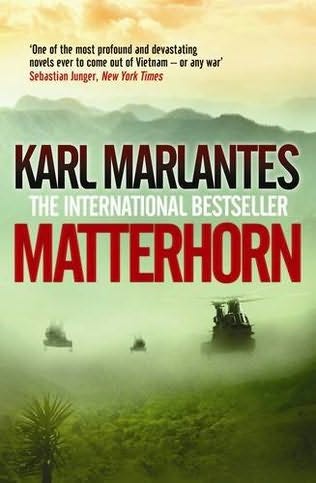
Lest We Forget: MATTERHORN by Karl Marlantes


Matterhorn by Karl Marlantes
Again, as was the case with my recent posting of my The Things They Carried by Tim O'Brien review, this review is clearly NOT of a book which fits the Ancient & Medieval tone of this blog. Vietnam war is classed as historical fiction, which is my primary interest, but that is not why I have posted this review here.
I am posting this review here because this is my only blog and this is one of my all time favourite books...of any genre. I want to keep this review stored on my blog and I want to share with you my personal thoughts on this powerfully evocative story.

I do not intend on making this a regular thing.  (Putting reviews here for books that don't fit the blog).
 At this stage, I believe this review and my review of The Things They carried, will be the only two.
And so, here is my review of Matterhorn by Karl Marlantes. Read a few years back, it still haunts me to this day....

Matterhorn. Karl Marlantes. What can I say? It has taken me a while to leave this review because it has taken that long to find the words.
Matterhorn is powerful, emotional, gripping, gut wrenching, but most of all, it is haunting.
Haunting. Yes, that is it most of all, it is haunting in a way that is beyond anything that I have read for a very long time.
I want to thank Karl Marlantes for the experience and the insight.
I want to thank him for sharing with me a story that I have no doubt has reflections in his own memory. But most of all, I want to thank him for keeping this war in my mind. Lest we forget, as they say.

Vietnam was not a glamorous or politically expedient war (if there is such a thing). We all know the stories of what society did to these Vietnam Veterans when they returned home, and we have all heard the horrible tales of chemical residues killing nervous systems and nurturing cancer. This we know and in many cases, it is all people bothered to know.
 People remember other wars and veterans with nostalgia and Vietnam with indifference. I was born in the 70's, too late to feel the tension of Vietnam, so perhaps I will never understand why this is.
There are books aplenty on WW1 and 2, and people devour them readily. Sometimes these wars are romanticised too much and this finds them favour with readers.
The Vietnam War is hard to romanticise and so it rarely finds fertile ground in the minds of younger readers. And I suppose I can understand. It is easier for those of certain constitutions to read stories of hope. Stories of survivors. Stories of heroes, of dog fights in beautiful old spitfires, of spies, of Nazi occupation, of secreting Jews out of Germany and Paris, of the beaches of Normandy, the ocean islands of the Pacific.
Vietnam - compared to these wars filled with heroes - had body bags and political protest, and men dying in jungles for unknown political reasons, chemicals, resume hunters and, of course, officers needing to prove that they had once won status in Korea.

So again, I thank Karl Marlantes for bringing me his Vietnam. As a place where men and boys from a Coalition fought men and boys from Vietnam and both sides lost.

- MM

Thursday, 23 January 2014

Hey kid, who are you REALLY?

How does what we read as a child affect our reading tastes as adults? I often see my childhood self in what I read today. Something in the books that we were made to read forged a fire within me that still burns now.
There are some mysteries I am yet to solve, but overall, as if looking into a crystal ball, I can pinpoint when precisely my favourite genres formed, by looking back at what books I was introduced to as a burgeoning reader and a developing human being.

Naturally, there were some titles and interests that stayed in my childhood and didn't follow me out.. (even if I have tried to resurrect their adult counterparts I have failed). ie..books about ponies (Black Beauty, My Friend Flicka) and teen sleuths (Trixie Belden, Nancy Drew), but those really were my choice. Books chosen by a child's mind. I can see their influences in my adult reading history, but they are more connected to reading phases and not to an everlasting passion for genre.

It all started in primary school (other countries have different names for this period of education, so to define, primary school in my country when I was growing up, was 5 yrs old to 12 yrs old).
Of all the books we were asked to read in school, I am not sure who was electing them. I am not sure if there was some list put out by the Education Department or if the books were a mix of Education Department recommendations and a few personally chosen by the teacher. I guess I will never know as it has been a few decades since I was in Primary School and those teachers have long moved on.

It is surprising, considering that two books we read as a group of children in school were The Lion, the Witch and The Wardrobe and The Hobbit, that I didn't go into the fantasy genre more than I have. But, while the fantasy genre is the obvious link to those two books, there is also a not so obvious link.
Those who read them as a child and were drawn to the magic and dragons and mythical creatures may have gone on to love the fantasy genre as an adult. And I find that those that learned to love the fantasy genre as a child, will go on to love it for the rest of their life. They may have years without reading a single book, but they will always love fantasy. 

For others - such as myself - it was not the magic and mythical creatures that struck a chord with me as a child, it was the escape to other worlds for dangerous journeys and wild adventures.
To this day, because of these reads, I still want to and like to escape into other worlds, into the adventures and journeys of colourful heroes and heroines, only it isn't into fantasy worlds, it is into our own history through the genre of Historical Fiction.
I went through a brief phase in my twenties of reading some fantasy, but I have never been passionate about the genre. That was during a period when I did not know historical fiction existed (thought it meant romance) and all my friends were reading fantasy. It seemed only natural to read fantasy too.

So, my focus is adventure and journey. Through the beginnings with The Lion, The Witch and The Wardrobe and The Hobbit, and then complimented by other journey or adventure juvenile fiction like Watership Down or The Incredible Journey.
The fact that these are animal journeys made no more difference to my developing self than if the journey were with hobbits. 
Now I love books like The Whale Road (and all the books in the series that came after it) by Robert Low, the Raven series by Giles Kristian, the Warrior Chronicles by Bernard Cornwell, Byzantium by Stephen R. Lawhead and even The Shardlake series by C.J Sansom  (set in Tudor England, but Matthew Shardlake gets around a lot, having adventures).

What of those Trixie Belden and Nancy Drew books then, and my draw to modern military non fiction?
I know I read the teen mystery series' because my peers were reading them and the protagonist was a popular girl. Two influences that were intoxicating to a young schoolgirl.
As an adult, there came a time in my twenties where I went through a full blown crime thriller phase. It only lasted a few years and I attribute that more to wanting to have something in common with my father (something else we can blame childhood for).

As for the war..
Can it have come from these two books? I Am David and My Brother Jack? I think it must.
It was those books that created an interest in reading true war stories (never fiction, I have never been interested in fiction war stories), coupled with seeing the Peter Weir directed movie, Gallipoli.

I find it an eye opening thing to suddenly realise where my adult reading interests came from.
I always thought they came from who I am now. In this moment!
I never looked deep enough to realise my reading tastes, the ones I am most passionate about, are fed from a childhood memory. That the movies and other things I am getting into now, I have been into before. Decades before. They are all influenced by moments in my childhood.
 Is that stupid of me?  Has everyone else realised this already? Am I just slow to the blocks?
I had never thought about it until last year when a conversation with other readers and a past blog post of mine here on the Ancient & Medieval Mayhem blog, got me to thinking.

Hard to believe sometimes that even now, as a fully fledged adult, with my vast (?) maturity, vast (this is true) mortgage, and my vast (I am not as old as that makes me sound) life so far, filled with many different roads laden with a thousand life experiences....that I am still learning such simple things about myself. And how that, over multiple decades, the reader I was learning to be as a child never truly went away. She has been leading me by the nose my entire life and I only 'thought' I had shaken her loose with my much more superior and lofty adult matureness.

I guess I had better thank those couple teachers for their wise book choices then.
So, without further adieu....Thanks!.......whatever your names were. 
 (names withheld due to childhood grudges). :)

- MM


Monday, 20 January 2014

Carried a Step Too Far: THE THINGS THEY CARRIED by Tim O'Brien


The Things They Carried
This review is of a book that is neither Ancient history nor Medieval history.
Some may even question if it is even historical fiction, but according to many historical fiction standards (including the Historical Writers Association), the Vietnam War does fit within the realms of historical fiction. And because it is a personal favourite review of mine, I wanted to share it with the blog. So that it gets stored here with my other reviews.

My review of the haunting book, The Things They Carried by Tim O'Brien.

This is an extremely hard review for me to compile, because I am extremely conflicted on my impression of this book. And I think this reflects the very nature of the stories presented to us in The Things They Carried. They are conflicted, true, not true, true, not true. Happening truth, story truth. A maelstrom of fiction and non fiction that sometimes feels raw and poignant and sometimes feels exaggerated and fake.

I gave it 4 stars, and yet sometimes I think it was 3 stars, and then at other times I think was 5 stars. 4 stars, I beleive, is the line in the sand for me.

I feel the only way to review this book is to cut it into positives and negatives.
I trawled through a lot of online reviews looking for others who felt like I did about the negatives of this book, but whilst there are ample 4 stars and a few less than, no-one tells me why they dropped that star. I will tell you why I dropped mine.
It comes down to fiction and non fiction. I do not like my lines blurred. In war fiction written by a vet I like to feel that it is fiction drawn on life experience. In my Non Fiction, I like to feel that what I am reading is the vets true emotions and experiences without exaggeration or lies.
This book bludgeons both my categories and gives me something that is not quite either. And I hate to say it, but sometimes amidst the authors heart felt truths lies the lurking ugliness of falseness. Of exaggeration and drama created purely because the author had not much of a story to tell.
I feel this book is one long feast of platitudes.

And yet it is also emotionally scarring and based enough on truth to get me where it hurts.
In 'the Nam', in the jungle, there was a platoon of young men. Some of them died, some of them did not. Tim O'Brien did not, and he has tried to do his best to heal and memorialise and I beleive that he has done that to effect.
There are plenty of positives to this book. The writing for one is brilliant at times, the stories for their part are wounding at times.
There is not a doubt in my mind that the combination of O'Brien's writing and his wounding stories will leave every reader in a different state of contemplation in the end. For me, this was a 4 star book, for you it will be a 5 star book, for the rare few it will be 3 or less.

The fact is though, that this book was/is a bestseller and when you look down the list of reviewers on Goodreads there is one thing that you should notice. It does not matter what your race, your country, your sex or age, your likes or dislikes, your favourite genre of book, this novel has something for everyone and it is being read by all sorts. That, for the memory of our Vietnam Vets, is a very good thing indeed and that, is probably the biggest positive to come out of this book altogether.


- MM


Tuesday, 14 January 2014

Samurai Sauce: THE 47 RONIN STORY by John Allyn


47 Ronin by John Allyn
What a way to NOT start a New Year. It is the first half of the first month of 2014 and despite my hopes that this would be a big year for me and my reads, it has kicked off with a real let down.

I have seen 47 Ronin pop up in my friends' reading lists for a couple of years. I always thought it was a Young Adult book and avoided it as I only read adult fiction.
 Then recently, I was looking for a book with an Asian Medieval (or near enough to it) flavour to suggest as a monthly read in my book group. I researched 47 Ronin and could not actually find anything anywhere that implied it was a young adult book. I am not sure now why I always thought that it was. I have my suspicions that perhaps it was via word of mouth. Someone must have told me that it was. It wouldn't surprise me if that were the case, because if there is any book that suits the title young adult more, it is this book.

It isn't that it is a story about children, don't assume that, it is more about the way it is written. It is simple, lacking in depth. In fact it did not surprise me to learn that the author was an editor in the television and motion picture industries and then a pictorial censor in the army later on. There is something about the way this story is written that reflects a mind that is used to cutting the fat and censoring. Only over editing can explain why this book suffered so from a complete literary devolution.

The characters were strangers to me. I did not know any of them in the entire book. Could barely tell them apart because the author attached no uniqueness to them.
The setting and environment, where depth of descriptions and cultural laminations should have been laid one atop the other to form a contextual feel (an important facet of historical fiction), were completely missing.
The best way for me to describe the lack of layers to this story is to say that I do not believe the author knew enough about the Japanese mind to write this book. He knows enough about Japan and its languages due to his career specialities, to think about writing a book about the Japanese, but I still think he has had some trouble working out who the Japanese male is. Or at least, who the Japanese warrior is.

The writing itself was not so bad. No glaring offenses there as far as technical skill goes. It was just basic and uncomplicated writing.

I cannot say if there are better historical fiction books out there which will offer a better viewing platform to the culture of the Japanese Samurai, as I have not read many on the subject, but I think you should probably try 47 Ronin. It may have more appeal to others than it did to me. I am fussy when it comes to writing and adult fiction. I expect a certain standard of characterisation and scene development. Not everyone has these same standards.

Apologies that I have not gone into what the book is about or who the characters were. To be brutally honest, I have no idea what the book was about and who the characters were. The whole thing was a mystery to me. I couldn't get into it or appreciate what was going on.
I did not know who was who or which way was up and that reflects in my rating for this book. 2 stars out of 5.


- MM