Thursday, 10 October 2013

Holy Theological Coma: THE NAME OF THE ROSE by Umberto Eco


Name of the Rose by Umberto Eco
I don't know why I should feel embarrased that I did not like nor appreciate this book. I am confident in my intelligence. I don't claim to be sporting the latest in super intelligence, but I am comfortable with the fact that the reason I did not like this book has nothing to do with it being 'beyond my intellectual reach'.

Still, when a book is regarded as a Classic. A work of genius. A “novel of stunning intelligence, linguistic richness, thematic complexity”(that's off the back of the book). And is as admired as this one, even the most confident reader can feel a little shy about coming forwards with a negative review. Shy because if the book is of “stunning intelligence”, what does that say about the intelligence of a reader who does not appreciate the book?

With such pressure to avoid looking like the village idiot, it would interest me to know how many people rate this book favourably (such as giving the book 3 stars when they feel it should be 2) and what they really want to say is “as a work of fiction, it, really, was not that great” (that's not off the back of the book, but will be off the bottom of my review..when I get there).

Let's break it down. Briefly (unlike Eco, I know how to keep it short) dissect the sum of its parts.
And there were really only two parts. Two roads. Two roads travelling paralell to each other through this novel of stunning intelligence, linguistic richness and thematic complexity.
One road is a medieval mystery set in a monastery, and as a medieval mystery set in a monastery, it was simplistic and on its own, could not stand alone.
The other road is a journey of over intellectualising and I loathe over intellectualising. Most of the time it is just included in a book because the author is carrying all this knowledge in their head and they want to flex their brain muscle and flash readers of the world their guns of knowledge.
It is the equivalent of the author who does all the clever research for their book and then needs to include all that research in their book so it does not go to waste.

So, as I travel the roads of simplistic medieval mystery and self indulgent brain flexing I walk, quite unsuspecting, into an unwelcome glut of theology. Like a fat boy devouring a buffet of cheese, Eco's ramblings about theology and philosophy dominates the offering and fills the room with an odorous fug. And for me, a person who cannot stand theological or philosophical discussion, it was a story killer.

I was suffocated and stifled. Unable to breath under the avalanche of manifest Catholicism.

It may seem strange then when I admit there was a time where I loved the book and found it both stylish and classy. Not so strange though when I admit that I only felt that way for the first 50 pages or so. Everything beyond Brunellus' horse was a tribulation for me and it went from love, to kind of still enjoy, to loathe and with about 100 pages to go I actually felt a knot in my gut at the idea of forcing myself to finish it. Mouldy old cheese will do that to you. Bind you up inside.

I understand that not everyone is going to feel this way about the book as there were personal taste issues thrown into the pot.
For me, this was, as you can tell from this review, not a marriage made in heaven. It has fortified my resolve to stay clear of historical fiction themed around monks and nuns.
Religion is not a part of my life by choice (nor is philosophical meanderings either, mind you), but for me, if you cut out the fat, cut out the ramblings, the theology and philosophy and the bla bla, as a work of fiction, it still was not that great.


- MM


Wednesday, 9 October 2013

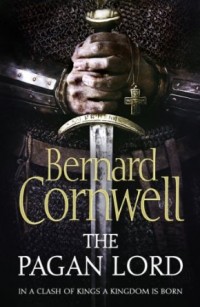
Uhtred Strikes Again: THE PAGAN LORD by Bernard Cornwell


The Pagan Lord by Bernard Cornwell
This may sound odd coming from a woman, but I identify with the main character of this series in many ways and as long as Bernard Cornwell doesn't mess with that character too much then he will always hit true with me as each new book in the Warrior Chronicles (officially known as the Saxon Stories in the US, France and some other countries) is released.

The lowest I have ever rated a book in this series is 3 stars (out of 5) and I believe, of all seven books so far in this series, I have only done that once. With Sword Song. Book Four.

The Pagan Lord, number seven in the Warrior Chronicles, was one I had been practically foaming at the mouth to read. The name alone got my guts churning. The Pagan Lord. A violent kiss of a title that had most Uhtred of Bebbanburg fans clamouring to pre order.

Would this be the book in which he won back his ancestral right? His beloved Bebbanburg? Would he be able to usurp his Christian uncle, Aelfric, and take back his home? We know it happens eventually. After all, from book one he is narrating as a very old man happily ensconced in his Northumberland fastness. Safeguarded from the judgements of Christians Kings and their nobility. A pagan lord of Northumberland in his twilight years. Only, what age he gains it all back has been a secret the author has been reluctant to share. Maybe Cornwell did not know himself when it should happen. Who knows. But it is an act of revenge the fans have longed for since the very first book, The Last Kingdom.

If he takes Bebbanburg or not, is up to you to discover. If you are a fan of this series then you would know it is the greatest of prizes and the surprise should be yours to stumble upon. I hate ruining surprises so I will only speak of  how this book made me feel, and of the non spoiler elements. The plot itself, it is all yours. So go get it when you are ready.

Considering the churning guts and the clamouring to preorder, it seems wrong to give the book less than a perfect score, but I had to give it 4 stars out of 5.

It is a great story and Uhtred is back in force. Age has not overwelmed him yet. He is as strong and as forthright as he has ever been, only he is probably a lot grumpier.
 He was always a grumpy and condescending sod of course, only now his grumpy is erring to the side of old man grumpy. You know the sort.  Bullish, quick to temper, short of tongue, a form of irascible that only age or pain can make you. And, if that were not enough, he is a father to boot. Of adult sons. What a treat that was. To see Uhtred in a whole new light. Portrayed in a way we have not seen before.

Giving Uhtred some age and some grown sons gave the book a freshness that I appreciated. I did not neccesarily like every plot turn and perhaps I did wish for more originality out of the plot turns I did get. There was also some odd repetition. Events described or relayed in the narration that were repeated nearly word for word a few chapters on (was that always the case? Did I just not notice this happening in previous books in the series?).

I also felt that Cornwell may have blown a perfectly good chance to hit the market with a crisp and shiny new formula that would excite fans for the books still to come. There was some newness to the formula in the form of, as expressed, an older main character with adult children, but it wasn't entirely what I was after in this book.

All that aside, it was terrific to be back in Uhtred of Bebbanburg's head and while the plot had it's flaws for this rabid fan, I was positively glowing as I joined my old kindred spirit once more on his life journey.
There is no character like Uhtred of Bebbanburg and for that alone I am grateful. The formula may follow the same lines in a way and the books are always too short, but my gratitude translates to unashamed joy and I will line up in a couple years, frantically foaming at the mouth once more, to feed my unhealthy Uhtred addiction.


*NB: I got to interview the author, Bernard Cornwell, about The Pagan Lord and the series in September for the Historical Novel Society. To read the interview, go here:  http://historicalnovelsociety.org/snarling-back-to-life-bernard-cornwell-on-pagan-lord-uhtreds-latest-blood-drenched-outing/


- MM


Wednesday, 2 October 2013

Unlucky in Life: THE ILL-MADE KNIGHT by Christian Cameron


The Ill-Made Knight by Christian Cameron
This was (to date) the most enjoyable book I have read this year. Not the best, no, that is a title that belongs to another book by a different author, but it was the most enjoyable and to me there can be a difference between most enjoyable and 'the best'. I hope to expound on that as this review progresses.

The Ill-Made Knight is unique in that it blankets the world of knights and chivalry like none other that I have read. If any comes close, maybe it was Men of Iron by Howard Pyle, but then the study of armour and armoury has come a long way since that was written and it has been so long since I read it. I could be wrong.
Part of the reason it does unique so successfully has to have more than a little to do with the author's love of re-enactment and living history. Playing with swords and armour and doing it all on horse back is Christian Cameron's hobby and the book benefits from that immensely. There is no better research an author can partake in than a living history experience.

I say the book is unique, however it was not wholly unique, and I hate it when I find myself comparing books, but I cannot help myself, I have to make a comparison. To me, while the subject matter – the chivalry, the emphasis on the culture of chivalry, the details of armour and weaponry – have been done in a unique way, the story and the main character reminded me over and over, of Thomas of Hookton and the Bernard Cornwell series, Grail Quest. Sometimes I felt William Gold and Thomas of Hookton, whilst borne from the minds of different authors, were blending. So many authors glean their inspiration from Bernard Cornwell's writing, that even though their own writing is not meant to mimic, sometimes it can. I don't know if that was the case here. If Christian Cameron was/is a fan of Bernard Cornwell. Maybe the character similarities are purely coincidence. Maybe to others there is no similarity and it is just me.

Comparisons, uniqueness and criticisms aside (and there are criticism - they are yet to come in this review), this was a fantastic book and promises to be a brilliant series. It will find fertile ground with a whole new fan base that the author has not yet tapped into since so far his books (not including his novella ebook only things, because I don't regard them as books) have all been set in Ancient eras. This is the book, and the series, that will get him the attention of the Medieval reader.

I gave the book 4 stars out of 5 and, suffice it to say, I do have my criticisms.
  Firstly, let's get the most offensive one out of the way. I do not ever think there is any reason why an author need go into too much description when writing a child rape scene. The child rape is briefly described and yet so vividly described.   Readers are a smart enough bunch. Authors do not need to describe it that much.
So that's that. I mention it in my review because I know many readers who would like the warning. I understand that the author may be offended that I have brought this up, but then I am offended as a reader, so I suppose that makes us even.
An editor should have shaved those scenes of the excessive description. I cannot imagine why they did not.

Speaking of editors. This book was riddled with errors. The wrong spelling of words eg though instead of thought and typos galore eg pregnat instead of pregnant.
The book was especially rife with them in the back half.
And "like a passion play"'. The author used variations of  "like a passion play" at least five times. The use of the term is something one notices as it is not common, so when it keeps appearing, it becomes a flaw.
 It was as if it had not actually been spell checked thoroughly (which clearly it hadn't) or even put under the eyes of a professional editor. Which is a shame as so much else about the book, like cover and in fact the writing itself, was very professional.

Also, a small matter. There was a glossary that I found lacking. A glossary that detailed armour and armoury and yet there were many missing off it like buckler and some kind of dart or little arrow (I know the name, but the name escapes me now). There were others, but those were the two I remember because I would have liked to see a description in the glossary.

These errors made me question whether I should be giving the most enjoyable book of the year a full five stars. I think a half star should come off my rating for them. But when it came down to it, it was the contrived feeling of the William Gold hard luck story that really wore on me and stripped that star down to make my rating four out of five. I was having a blast with the book for the first half. Only that everything that could go wrong did go wrong and I found myself thinking more and more that it was too much. That surely something has to go right. That it would have been to the betterment of the story to have a few little rays of sunshine.

One wee thing before moving on, which isn't such a negative, just a note of interest. The book has no chapters. It has about three Parts and there are scene breaks. But no chapters. I like chapters, they are good places to rest up. Still, it wasn't too much of a pain and I hardly noticed until about halfway.

William Gold truly is the most unlucky bastard that ever lived.
An elaborate sketch if I may...
Picture this. A man walks across a cobbled road and trips over a stone and falls, he gets up, straightens his clothes, walks in the door of a pub and hits himself on the door frame. Rubs his head, walks inside, then gets hit in the face by a wayward punch in someone else's bar fight. Picks himself up, orders a beer, walks to a table sits down and a chair leg breaks and he goes down. Gets another chair, goes to drink his ale and the handle comes off and the ale goes into his lap. Poor unlucky bastard gives up, walks back into the street. Cart goes passed and splashes muddy water all over him. See's a whore, tries to procure her services only to find a hole in his pocket where his money fell out. Gets stabbed by the whore's pimp.

The entire book was like this. Only take out the tripping and broken furniture and passing cart and add in all the events that befall William Gold.
Aye, he truly is the most unlucky bastard that ever lived and as the story goes on it did not feel at all natural.
It was not a deal breaker though. I could still really enjoy the book despite it. It's just that I could have enjoyed it more.

Taking into account typos, errors, repeating of phrases and the downer of nothing going right for the main character, I give the book four stars out of five (as mentioned). But that is not the entire story. The book is still a lot of fun in parts. Was well written. Imaginative. And captured the era well, in my opinion. I am eager for there to be a book two. This series will no doubt go from strength to strength.


- MM


Monday, 23 September 2013

The Day Medieval Mayhem Interviewed Bernard Cornwell

I was lucky enough recently to be asked by Richard Lee over at the Historical Novel Society,  to interview Bernard Cornwell for the September/October releases of the latest book in the Warrior Chronicles/Saxon Stories - The Pagan Lord.

This historical fiction series is right up there in equal first position on my favourite series' of all time list (a list I only keep in my head) next to Robert Low's Oathsworn series.
So you can imagine how honoured I was to have been asked to do this interview with Uhtred's Dad,
Bernard Cornwell.

I did not realise, until it came to organising the ten questions on paper, that I already had some questions rattling around in my coconut. Things I must have pondered on many occasions as I read the series over the years, because when I sat down to compile the interview, most of the questions tumbled out effortlessly.

This was the final result.

Thankyou to Richard Lee at the Historical Novel Society and to Bernard Cornwell for this opportunity.


Snarling back to life: Bernard Cornwell on Pagan Lord, Uhtred’s latest blood-drenched outing
http://historicalnovelsociety.org/snarling-back-to-life-bernard-cornwell-on-pagan-lord-uhtreds-latest-blood-drenched-outing/


- MM

Thursday, 19 September 2013

How Much is Too Much? - Child Characters in Historical Fiction


This opinion is an extremely personal one, since I know that the opinions on child characters in adult historical fiction are as broad and as varied as the shifting sands of the wondrous Thar Desert. So if your opinions are vastly different to mine please share, or at least, don't be offended, I respect that everyone has unique takes on what they like or dislike in books and what they notice or do not notice in books.

Child characters. How much time is too much time for an author to spend on them? How much of a book should childhood take up? I have always had a personal opinion that a character's childhood should not take up more than approximately a third of a book. It doesn't matter if it is a trilogy or a series or a one off. To me, if it is adult fiction, an author needs to not wallow too long in the childhood. Use a critical eye. Is every scene really that important in developing who a character will become when grown up? Or are you enjoying reliving childhood on your pages and forgetting the adult who will come to read it?
It is, after all, much easier to write like a child about a child than it is to write like an adult about a child.


Only grown ups have swords!
I have an exception to my 'third of a book' rule. If an adult is narrating I find it all right to hang about in the childhood of characters for longer. Example; the Saxon books by Bernard Cornwell, or the book I am reading now, The Ill-Made Knight by Christian Cameron.
In these examples the narrator is an old man and he is telling the story of his youth. When this is done well, the reader feels the adult in the story. Feels the story is an adults version of events. The subject matter does not feel as juvenile with this technique and us, the readers, do not feel like we are being forced to get inside a teen boy or teen girl's head. Goodness, I did not like teenagers when I was one. I certainly do not enjoy them in my books...for too long that is. Note: third of a book. I have my tolerances.

Take out the 'old man narrating' device and there is the danger that the author is writing a child's story, a Young Adult book. The author may not like that kind of feedback, but it is a very real danger and there should be some understanding when an adult says “it read like a Young Adult book”.
This is not always meant as an insult, although I am sure some mean it to be. When it is not an insult but an observation, it is due to a book actually reading like it was written for late teen to early twenties, or the adult reader who likes to sometimes read with their inner child and chooses Young Adult books to explore that sensation.

Strangely, I find majority of authors write in a simplistic and juvenile way when they are writing
child characters. This is the only way they know how to attach a sense of child to the story of childhood. Only it comes off as childishness instead. Some kids playing with wooden swords should not read like Elmo is telling us about pool noodle fight night at Sesame Street.

Oh, and before I go on, I would like to add that including some graphic violence or a sex scene into a childhood story does not help to attach an adult feel to the story. It is the voice being used that attaches an adult feel and not the events being told on the page.

I do not read Young Adult books. I have nothing against them, there are some wonderful young adult books in the world that delight a plethora of readers. Readers through a full spectrum of ages and occupations.
I, however, have no interest in them. I will never like reading for long periods about teens or children. I want to read about adults doing adult things. I guess it is because I want to picture myself in these books sometimes, as I devine the wonders of escapism. I guess also, that it is because I am an adult who left her childhood behind her.

I am not alone. I know that. While there are many people who like a book that is dominated by the childhood of an adult character there are just as many who do not like it and I think an author needs to work out how to make both sides happy. Writing is a profession after all and the readers are your customers. A writer needs to understand the intricacies of blending childhood and adulthood in one book, even if that book is the first in a trilogy or series.

Find a way to plant your literary feet on both sides of the issue. Create childhoods that read in a mature, adult way and then know when to get out of them, or you may as well be writing a book for teenagers.


- MM


Wednesday, 18 September 2013

The Bruce Take Two: RENEGADE by Robyn Young


Renegade by Robyn Young
Renegade (book two in the Insurrection Trilogy) was another solid offering from bestselling historical fiction author Robyn Young.
It detailed many of the more interesting events that took place during the lifetime of Robert Bruce and I am sure you will be moved by the way the author has presented them.

While I thought the book was a good read, I have to admit it read differently to the first one, Insurrection. I would even go so far as to say it was dramatically different. So dramatically different that I believe many of the people I know who did not like Insurrection may find Renegade better suited to them.

It is no secret amoung my fellow bookworms. I fell in love with Insurrection. I cherished the power of the detail and the way I could feel Scotland on every page. While on the flip side, friends were finding fault in the same book. Saying that they think it lacked female characters and that the more personal drama of Robert's life was skipped over.

In this book I trust they will find what they had missed in book one, for the women have a strong presence and are explored to much greater length. While the connections between the men and the women are delved and kept relevant throughout.

To those who have inquired after my opinion of the book as I read it, I have tried to define what it is that I found so different about Renegade compared to Insurrection and this is what I came up with.
I feel Renegade was written more for those who read with their feminine side. Although I am a woman myself I read with my masculine side and, therefore, love-stories, melodrama and personal interactions between characters are not important to me when I read. It is not that I love battles, because I don't. I enjoy a good battle scene if it matches the book, but I hate battle-centric or gore-centric historical fiction.

Whether Robyn Young realised she had written Renegade differently to Insurrection, or whether it was planned based on feedback after Insurrection came out, or whether it happened of its own accord and the author wasn't aware, it doesn't matter. It was still a good book. The story is still done well and there are plenty of scenes that got my blood pumping.

I will recommend - to those who read book one and noticed a lack of female influence and missed a more up close and personal relationship with the characters - that they go on and read this one. It is the book I think they wanted Insurrection to be, or, in the very least, it is the book that includes some of those elements that they thought lacking in the first.

I must express though, that I did not find the first one lacking in any way. It became one of my favourite historical fictions and I will always treasure my copy of Insurrection.

As for me and the trilogy. I will await book three in 2014 with anticipation. I look forward to seeing what Robyn Young does with the finale of the Robert Bruce story. I am sure, even reading with my masculine side as I do, I will still perhaps shed a tear to see this trilogy come to an end.


- MM


Monday, 9 September 2013

Bordering on Personal Taste: STRATEGOS: BORN IN THE BORDERLANDS by Gordon Doherty


Strategos: Born in the Borderlands
The norm for reviews is to speak about the book, but I am going to break from that norm and open this review with a brief word about the author. I promise it will all tie together as integral to my evaluation of the book.

As an active reviewer of historical fiction books I do from time to time receive free copies of books to review and this book Strategos was one of them. I got to deal with the author personally on this occasion and as well as being acquainted with him that way, I also interviewed him on this blog and interacted with him in one of my groups (since this book, Strategos: Born in the Borderlands, was a monthly group read in Ancient & Medieval Historical Fiction Group).
Sometimes, even though you really want to give the author a high rating for knowing them, or out of guilt because you got the book free or out of misguided loyalties, you should not (if you value your integrity) give their book five stars when you don't regard it as a five star book.
I try to be an honest reviewer. I have a firm philosophy of  not reviewing for authors or publishers and only ever writing reviews for readers. By that I mean, while I will write reviews when an author or publisher gives me a book, the words in that review are personalised for my fellow readers.
 To put it bluntly, I don't do cash for comment.
A review in my opinion needs to reflect how a book made you feel. It is a chance to tell other readers what you did and did not like about a book.

So, since I cannot in all honesty give the book five stars, I wanted to open my review by saying what a pleasure it was to deal with the author of this book. He took my negative feedback with decorum and embraced discussions on his book with professionalism. Any author who interacts with readers like that should be valued and applauded.

Therefore, to the author I give applause, but to the book I give three stars.

When it came down to it, I have to confess that Strategos: Born in the Borderlands was a mixed bag for me. A book that made me pause as I read it. And I mean that literally (more on that in a moment).
Whilst I enjoyed the setting and some of the characters, I had some personal taste issues with the book and they put a creative block in my way.
What I liked about the book was the research the author had done and the gamble he had taken in writing in a little known era of Byzantine history. With so many authors jumping on era bandwagons, Gordon Doherty selected a thoroughly unique and fascinating story setting and went ahead to do a damn fine job of bringing it to the reader.

What I didn't like about the book. Well, this is where personal taste comes to the fore. The book has a lot of appeal and has gained a lot of fans who don't have the same personal taste issues as I do.
I have to give a small mention to formatting. In the edition to date there is double spacing between each paragraph (which includes after each line of dialogue). I have spent a lifetime, from learning to read as a child to adult, with large spaces after paragraphs in novels meaning scene breaks and it really messed with my reading flow to have such large spacing format applied to this book. It did affect my ability to get into the book more, so I have to mention it.

The other two things that I did not like that come down once again to personal taste are that this book technically is a historical fantasy. With visions of one person being shared by multiple characters. If books include fantasy, for my taste, it should be able to be rationalised to keep it straight historical fiction. And if it can't be rationalised then I believe a book should be proudly fantasy and go full blown.

But not everyone shares this opinion and that is why it is a matter of personal taste.

The other issue was that the book was mostly childhood. Half being about young children. The rest was predominantly late teen and I personally found that it read like a Young Adult book and since my personal taste is for adult books and adult issues I could not get an adult connection with the story. Some people may say that it doesn't read like YA because it has graphic violence in it, but YA does sometimes have graphic violence in it.
I accept that most series openers will have children in the start of the book. It is a common device when it comes to a Series or an Epic Fiction. But I don't like it to take up too much of the story. I like to be into the adult part of the character well before halfway.

I suspect book two Strategos: Rise of the Golden Heart would suit me more....if only I could be guaranteed that it did not include fantasy.


- MM

*Please NB: I interviewed Gordon Doherty on my blog if you would like to know more about him and his books: http://ancientandmedievalmayhem.blogspot.com.au/2013/08/interview-with-author-gordon-doherty.html

Thursday, 5 September 2013

Two Reviews, Oceans Apart: RAVEN: BLOOD EYE by Giles Kristian


Raven: Blood Eye by Giles Kristian
I decided my review of Raven: Blood Eye by Giles Kristian, would not be complete unless my review of it in 2011 was brought to the table too.
So, this is a review of two parts. Two reviews of one book, but years apart. In the name of equivalence.

I have a confession. I rarely reread. I know many people that love rereading old favourites, or books they have not read for a long time or books they want to try again to see if they feel differently about them, but I hardly ever do. Then if I do, it is usually for a good reason such as joining in with others in a book club read.
From time to time (and by time to time I really mean once every other year) there are books that I feel deserve a reread for one of two reasons. One, wanting to revisit a favourite book or series, or two, because I feel that when I first read a particular book my mood was not well matched to it at the time.
These 'poor mood matches' stay on my mind for a long time after and then, given the right push, I give them a second chance and reread.

One of those 'poor mood matches' for me was Giles Kristian's Raven: Blood Eye. I always felt that when I read this book in October 2011 it was a case of wrong time, wrong place.
On paper, it should have been a perfect fit. I love classy, intelligently written historical fiction. I love classy, intelligently written adventure and journey historical fiction. But most of all, I love classsy, intelligently written Viking or Norse historical fiction.
And Raven: Blood Eye checked every one of those boxes.
So why did it not click with me in 2011?
It is, after all, a well written book. The writing surprisingly skilful for a debut. I liked the setting, the characters, the era and yet my lasting memory of the book was that it was chapter after chapter of 'walking and thinking' or 'walking and talking' or 'sitting and thinking' or 'sitting and talking'. And not much else. Not exactly a blast, according to my 2011 self.

Boy, was I wrong. Because here I am August/September 2013. nearly two years on (See. Every other year. Didn't I say so?) and I felt like I just read a totally different book to the one I read back in 2011.

The Raven: Blood Eye I read this time had so much more going for it than I first assumed. It has adventure, (not only journey) and that surprised me. I have no idea why I did not notice it the first time around.

The book is rich in historical detail and rounded out with a robust norse culture and character.
I once compared it to Bernard Cornwell's and Robert Low's Viking offerings, but in actuality, it is nothing at all like Bernard Cornwell's Saxon books and shares more commonalities with Robert Low's Oathsworn books. That is a good thing, I should mention, since I think Robert Low's Oathsworn series is better than Cornwell's Saxon series.

For all these reasons I now think the book deserves 4 stars out of 5. There was still room for improvement in regards to plot and characters, but I have bought the next two books in the trilogy and we will see what Giles Kristian does with those. That 5 stars for a Kristian Raven trilogy book may still be on the horizon. Since the debut was so good I kind of expect the next books to be even better.

I also wrote a review of it when I read it in 2011 and now that I have shared my newfound affection for the book in 2013, let me pull you into my time machine and whisk you back to October 2011. To set the scene..I had just read a book called Raven: Blood Eye and I had just given it a weak 3 star out of 5 rating.

Please note firstly that I was not as wordy back in 2011 and perhaps you will think I should take a lesson from that. But in 2013 verbosity is so much more fun for me.

Goodreads Review - October, 2013;
This book was a bit of a disappointment for me. It looks the goods. Seemed promising out of the gate, but overall, it simply felt a bit flat.
The author can write well enough. There was no amateur writing to be had here, but the story, for me, was just words on a page. Nothing of note happens in a hurry through the meat of the book. Seemed to be a lot of standing or sitting around doing not much of anything.
I will still go on with the series at some stage. I figure that when the main character Raven becomes a man, and therefore makes for a much more interesting character to me, the story may hold more promise than this one.
I think here in the first of this series the author is trying to build a character for the other books leaving this one as a 'how the boy became a man' kind of read, which is important sure. I just wish he'd done it quicker and not made a whole book on it.
But I'll forgive him for now and let me see first what he does in book 2.

Where on earth was my head at back then? Irrespective, there you have it. Two reviews of the same book. One for 3 stars in 2011 and one for 4 stars in 2013.

Two reviews, oceans apart.


- MM

*By the by. If you are interested in knowing a little about the author, I interviewed Mr Kristian here on the Ancient & Medieval Mayhem Blog.
http://ancientandmedievalmayhem.blogspot.com.au/2013/07/giles-kristian-becoming-familiar-name.html